
Beyond AI literacy
A framework for learning and assessment in the age of AI
When AI can generate answers, what should students still learn?
Universities across the world are redesigning curriculum and assessment in response to generative AI. Most discussions focus on AI literacy. We believe the deeper challenge is different:
How do we develop judgement when AI can already generate increasingly plausible answers?
Developed by:




The core idea
Most AI-supported learning follows this sequence:
AI output → evaluation → improvement
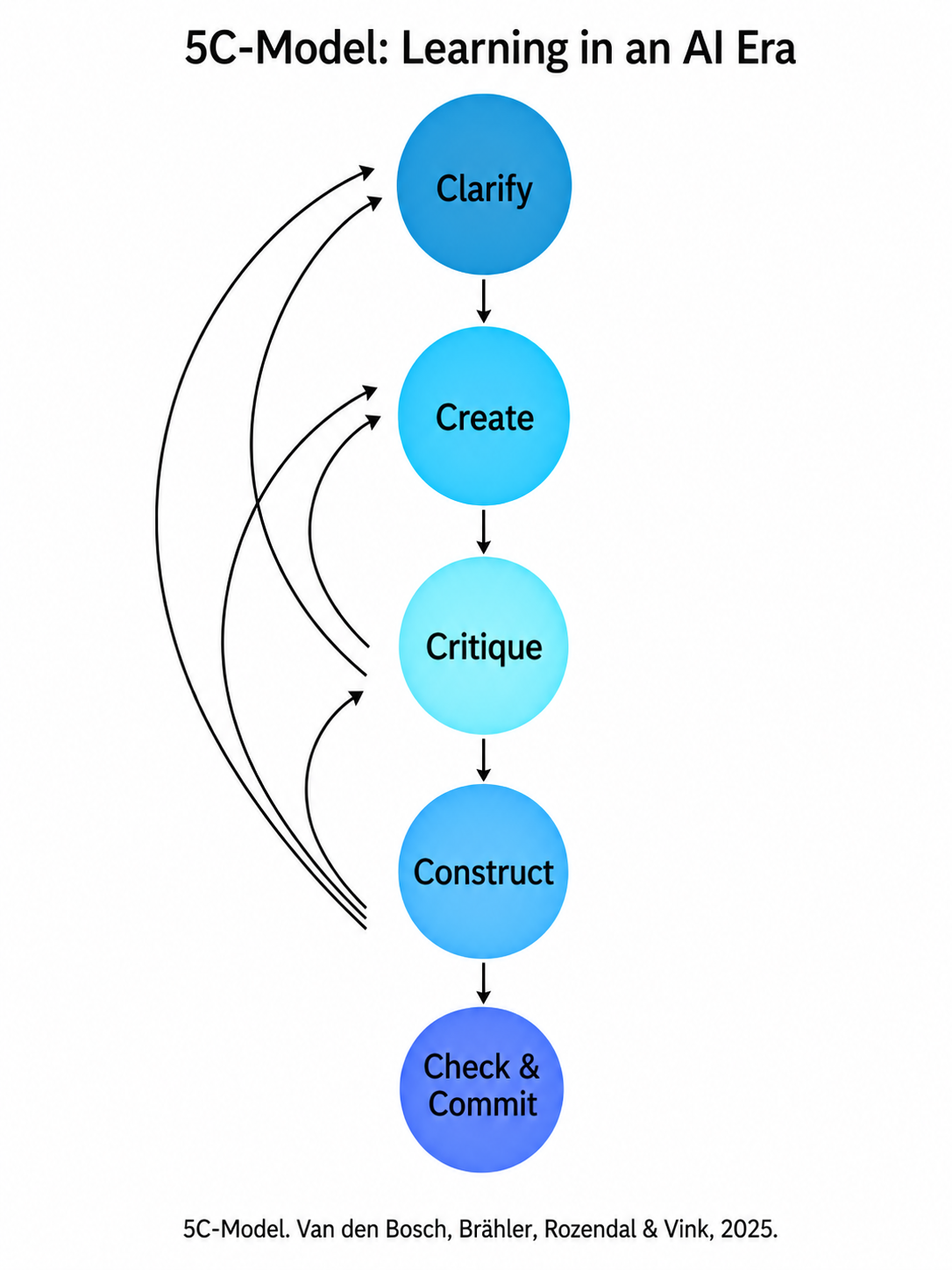
The 5C-model introduces a crucial missing step:
AI output → Wall of Ignorance → informed judgement
Instead of immediately evaluating AI-generated content, students first identify what they cannot yet judge responsibly. Learning becomes visible in that gap.
The 5C-Model
Why it matters
The question is no longer:
Can students use AI?
The question is:
Can students explain, justify and take responsibility for the decisions they make with AI?
Applications
The framework can support:
✓ curriculum redesign
✓ assessment redesign
✓ AI-integrated programmes
✓ faculty development
✓ professional judgement development
Working with programme teams
Many programme teams are currently asking:
What should assessment focus on now?
What evidence of learning still matters?
How do we develop judgement rather than dependence?
How should AI change our curriculum?
These are exactly the questions the 5C-model was designed to explore.
Want the theory?
Download the full paper below.
Interested in exploring this in your programme?
Book a 30-minute conversation or drop Nathalie Brähler or me (Inge) an email.